
AI Impact on Human Experience: The Fine Line Between Support and Substitution

Convenience changes people’s behavior long before they notice the cost.
Gone are the days when people spent time researching a topic of interest using reliable sources. Now, most people no longer hesitate before asking AI for help. It is available, fast, and makes things easier almost instantly, and that feels good. This is how the AI impact on human experience begins.
Over time, however, this convenience begins to shift how we perceive effort and how long we are willing to stay with a task, thought, or emotion before passing them on.
That is why the future of AI in daily life, regardless of its form, will no longer be perceived as a major event but felt as a minor change that becomes more normal.
When used with awareness, AI can support clarity, organization, and progress, reducing unnecessary pressure. When reliance becomes automatic, it steps into areas that previously required personal thinking, emotional presence, and deliberate choice.
This impact becomes easier to observe when work feels optional, patience decreases, and responsibility is postponed rather than being taken on directly.
Before it affects emotions or behavior, the impact first touches the way you think. It can be seen in how long you stay with a question and whether you try to solve it on your own or look for help immediately. That is why the cognitive impact arises first.
How does AI impact human experience?
AI affects thinking, emotional processing, communication, and behavior. It becomes support when used with awareness and substitution when it replaces personal engagement.
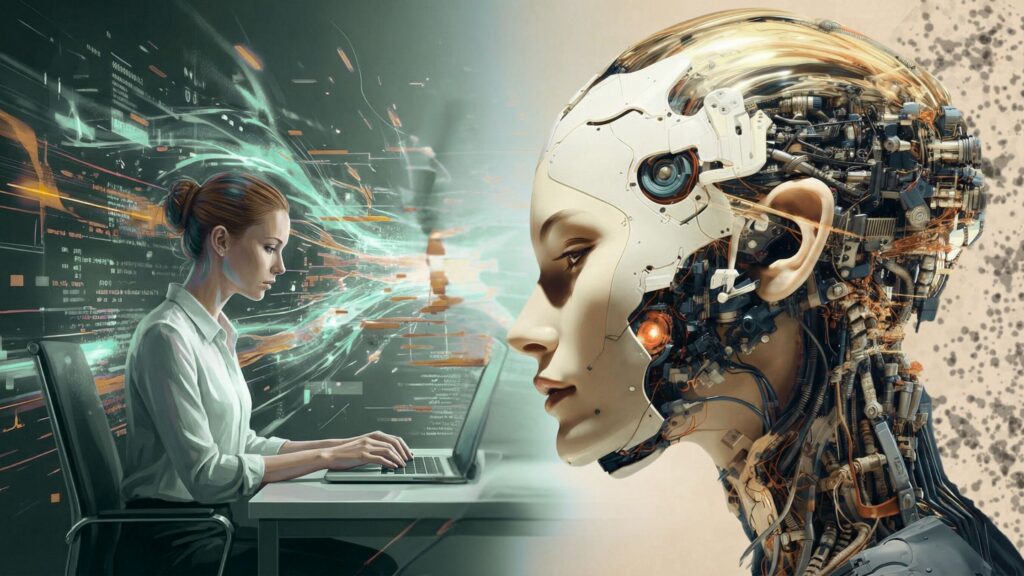
Understanding the AI Impact on Human Experience
AI affects human experience on multiple levels at once. Its impact is neither positive nor negative by default. What shapes the outcome is how it is used, how often it becomes part of daily life, and the level of awareness behind its use.
Below is a clear, structured analysis, grounded in real observation.
Cognitive Impact
Having AI available changes how long you stay with your own thinking. In most cases, when a question comes up, you don’t pause to think it through on your own anymore. The first instinct is to ask the AI directly. It offers you a clear, ready-made answer, straight and to the point, that feels enough, so you move on.
Over time, this becomes a habit. You stop earlier and settle for what feels sufficient, and the effort to fully think something through slips into the background.
When used consciously, AI helps when the mind is tired or overloaded, or when your energy is low. When used automatically, it shortens your tolerance for mental effort. You lean more on external answers and spend less time working things out on your own.
The result isn’t an instant loss of intelligence, but a slow erosion of how intelligence is used. Thinking ends sooner than it used to. In practice, this shows up when questions are closed quickly instead of explored, and answers are accepted without being checked against your own reasoning.
Key risk: outsourcing your thinking.
When AI starts to think for you, not alongside you.
Communication Impact
When AI is used frequently, it alters how people communicate, particularly in real, face-to-face conversations. Getting used to having words ready and thoughts already organized affects how you speak when nothing is scripted, and you actually have to express yourself.
Real conversations are not neat or clear. Emotions get involved, words don’t always come out right, and meaning is built as the conversation unfolds. When you’re used to having that work done for you, these moments feel heavier. You pause more, you search for words longer, and saying what you really mean feels harder than it used to.
You can notice this in everyday life. You avoid conversations or only answer briefly instead of explaining. You choose silence rather than trying to say something imperfect. When emotions come up, putting them into words feels difficult because you don’t practice that part as much anymore.
As this repeats, communication loses depth. People still talk, but the human connection becomes more broken and less meaningful.
AI can’t replace tone, body language, pauses, or emotional tension. When it’s used often as a shortcut, those social skills are applied less. Communication doesn’t disappear, but it carries less of the person behind it.
Key risk: weakening human communication.
Avoiding real conversations in favor of scripted interactions.
Emotional Impact
The Emotional Trigger and The Immediate Relief
In real life, the emotional trigger arises when something feels off, and it doesn’t settle on its own. You feel uncertain, frustrated, emotionally tense, or simply alone with a thought you don’t know how to handle. It’s uncomfortable, and the instinct is to make that feeling go away as quickly as possible.
That’s when you turn to AI for immediate relief. You describe the situation or the feeling that bothers you, and the response comes almost immediately. It puts things into words, offers reassurance, or reframes the context in a way that makes sense. The tension eases, you calm down, and, in that moment, the relief feels real.
Sometimes, it genuinely helps because you don’t have to sit with the discomfort or figure things out on your own.
The issue appears when this becomes the default way emotions are handled. The emotional discomfort is consistently handled externally, rather than being processed internally.
The relief comes fast, but the emotion itself is cut short. You move on feeling calmer, without understanding what triggered the reaction or what it was trying to signal.
Emotional Substitution
With time, this pattern changes the relationship you have with your own emotions. Discomfort becomes difficult to tolerate, and the impulse is to remove the feeling without understanding it.
Emotional regulation shifts outward, and reliance on AI replaces skills that usually develop through reflection, human conversation, or professional support.
For many people, this also fills something else. When there’s no one around to talk to, having something that listens and responds can feel comforting. It can feel easier than opening up to a friend, and much easier than seeking help from a licensed specialist, which takes time, effort, money, and vulnerability.
AI is always there, and it asks for nothing in return.
The Cost of Skipping the Inner Process
AI is also not always reliable in this role because it responds based on automatic patterns. It doesn’t know the full context, your history, emotional patterns, or the blind spots that you tend to avoid. Sometimes it reassures when reflection is needed, and it validates when questioning yourself would be healthier.
This is where the line between support and substitution appears. AI can help you regulate emotions, but it can also train you to skip the inner process. It cannot replace emotional awareness. When it takes on that role too often, emotional understanding stays shallow.
For this reason, best practices for using AI responsibly include knowing what you shouldn’t outsource when you are emotionally charged. What you lean on in those moments becomes your pattern.
Key risk: artificial emotional regulation.
Emotions are not processed, only temporarily soothed.
Behavioral Impact
When AI becomes part of how you think and handle emotions, it naturally influences your approach to situations. At some point, using it no longer feels like a deliberate choice. It’s just there, automatically, part of how you go about things.
We all use AI to some degree, and that’s perfectly fine when it helps you organize your work, make sense of a confusing situation, or save time on repetitive tasks.
These are normal, practical ways AI can be useful, as long as it stays a support tool and doesn’t replace your own thinking or decision-making.
The negative shift happens when you start relying totally on it. Before making a small decision, you ask if it’s the right move, or when trying something new, you want reassurance that it will work. You start relying on simple suggestions or guidance for things that need a personal touch and that you used to handle on your own.
You stay busy, even productive, but you’re less self-directed. The trust in your own judgment weakens, approval replaces decision-making and learning from the outcome, and you have less autonomy over your actions.
Over time, this affects how you move through life. You take fewer small risks, experiment less, and rely more on guidance for actions that once felt natural.
When reliance shifts in this direction, AI doesn’t just support behavior. It changes where decisions come from and how many of them still belong to you.
Key risk: delegating personal responsibility.
Avoiding ownership of your own choices.
Brain Experts Warning
In an engaged interview, podcast host Stephen Bartlett speaks with Dr. Daniel Amen, a psychiatrist known for his work on brain health and clinical neuroimaging, and Dr. Terry Sejnowski, a neurologist and a pioneer in computational neuroscience, about what changes in attention, memory, and decision-making occur when AI becomes the first stop instead of a support. Their conversation adds grounded context to the cognitive and behavioral patterns discussed in this article.
Frequently Asked Questions
Q: How can I tell when AI use has become excessive for me?
A: A practical sign is noticing whether you feel uneasy starting to think, write, or decide without first checking with AI. If hesitation appears before you even try on your own, reliance may be replacing engagement.
Q: Can AI reduce creativity, or does it enhance it?
A: It can do both. AI can offer prompts or structure that support creativity. Creativity is weakened when original exploration is replaced by ready-made patterns rather than being expanded by them.
Q: How can I use AI without losing mental autonomy?
A: By setting a personal boundary around when AI enters your process. For example, thinking through a question first, then using AI to refine, challenge, or broaden your perspective rather than to replace it.
Q: Does frequent AI use change attention span?
A: It can influence how long you stay with a thought. Repeated exposure to instant answers can shorten tolerance for mental effort, especially when combined with other fast-feedback digital habits.
Q: Is this impact reversible?
A: Yes. The patterns described are habits, not permanent changes. Awareness, intentional pauses, and reintroducing personal effort into thinking and decision-making gradually restore mental engagement.
Final Thoughts
AI is already part of daily life. That’s a fact. The real difference is not whether it’s used, but how consciously it’s used. AI does not remove human responsibility. It changes the conditions under which responsibility is exercised.
When used consciously, AI remains a support tool. When relied on too heavily, it turns into a substitute for thinking, emotional processing, and decision-making.
The line is crossed when convenience replaces engagement, and thinking is shortened rather than supported. It happens when emotions are bypassed rather than understood, and decisions are put off instead of owned.
The real question is not what AI does to people, but where its role ends, and yours begins. The fine line between support and substitution is not defined by the tool itself, but by the relationship you build with it.
This topic is not abstract for me, and I doubt it is abstract for you either. AI is already part of how many of us think, organize our days, or make decisions, even when we don’t frame it that way.
What interests me most is how this looks in real life, not in theory: where you notice AI stepping in first, where it genuinely helps, and where it replaces effort or presence.
Those patterns are distinct for each person, and they say more about our habits than about the tool itself. If you feel like sharing your experience, what you’ve noticed in yourself might help this conversation stay grounded in reality rather than assumptions.
Until next time, remember,
Help is useful. Dependency is costly.
This article is well thought out and very knowledgeable with how AI interacts with the human concept and what it takes away from people doing, learning and processing. I have found that AI is becoming more and more a readily used option to people not having to learn but for our youth, it is a way of life and they would not know how to do life without AI. It has made so much in the world easier. From work, to creativity, to articles and it removes a human presence to so much. I have a hard time defining good from bad because there is so much of each. I like that this article makes you look at it all.
Quite a thought-provoking article you have here. I’ve noticed that I now go straight to AI for small things at work, like structuring emails, even when I could figure it out myself. It’s faster, but I’m also less patient with my own thinking than I used to be.
I’m curious what this does to focus and mental endurance in the long run.
Hi Michel,
When small tasks get outsourced by default, it becomes harder to notice where support ends and dependency begins. Focus and mental endurance don’t disappear. They get used less.
What you don’t use regularly becomes harder to access when you actually need it. That’s usually when people first notice the change.
Hello Diana,
I used to be hesitant about AI because I worried it might distance us from real human experience. Over time, I started using it for repetitive work tasks, and that freed up time for the parts of my work that actually need me.
I’ve noticed the same at home with planning and organizing daily tasks.
What stood out to me in your article is the idea of intentional use. The tool itself isn’t the issue. The habit of how and when it’s used is.
How do you think people can keep that line clear as AI becomes part of everyday routines?
Hi Alexa,
Thank you for your feedback. The balance is kept through boundaries. People don’t lose it because AI exists, but because they stop deciding where they want effort to stay human. Long-term, the line is maintained only when the choice to think, decide, and process on your own is made deliberately, not by default.